
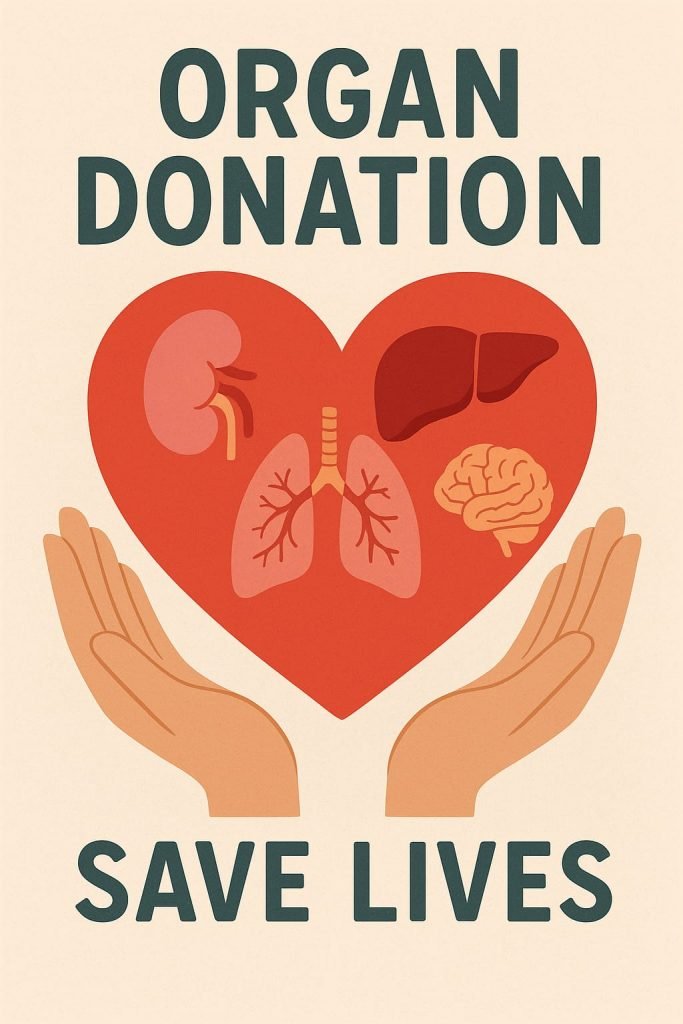
Organ Donation – The Greatest and Most Important Gift
- Introduction
Organ donation is not merely a donation – it is a gift of life. After a person’s death, their organs can give new life to many individuals. Across the world, and in India too, thousands of patients are waiting for organ transplants. In this situation, awareness and active participation in organ donation are of utmost importance.
- What is Organ Donation?
Organ donation means donating one’s organs, either after death or sometimes while alive, for transplantation into another person.
Organs include:
Heart
Liver
Kidneys
Lungs
Pancreas
Eyes (Cornea)
Bones, skin, and heart valves
- Types of Organ Donation
- Living Donation – While alive, a person can donate one kidney, a part of the liver, bone marrow, blood, skin, etc.
- Deceased Donation – After brain death, organs such as the heart, lungs, liver, kidneys, and eyes can be donated for transplantation.
- Need for Organ Donation
In India, thousands of patients die every year while waiting for organs.
Organ availability is extremely low – for example, India’s organ donation rate is only 0.5 to 0.8 per million population, whereas in countries like Spain and the USA it is 20–30.
A single deceased donor’s organs can save up to 8 lives and improve the quality of life for more than 50 people.
- Brain Death and Legal Procedures
Brain death means the permanent cessation of all brain functions.
In India, under the Transplantation of Human Organs and Tissues Act (THOTA) 1994, brain death is considered legal death.
Brain death must be certified through medical examination at two separate times before organ donation can begin.
Hospitals performing transplants must be registered as Authorized Hospitals.
- Process of Organ Donation
- Pledge – Register your wish with NOTTO (National Organ and Tissue Transplant Organization) or state-level agencies.
- Family Consent – Written consent from the family is required after death.
- Medical Examination and Matching – Blood group, tissue matching, and medical criteria are checked to select the recipient.
- Surgery and Transplantation – Organs are removed by trained surgeons and transplanted immediately.
- Barriers and Misconceptions
Religious misconceptions – Most religions permit organ donation as an act of charity.
Family reluctance or emotional hesitation.
Lack of awareness about brain death – Many think it is like a coma, but it is irreversible death.
Fear of complicated legal procedures.
- Measures for Awareness
Organize lectures and campaigns through schools, colleges, and social organizations.
Mark Organ Donation Day, health camps, poster competitions, and use social media.
Share inspiring stories of donor families.
Train healthcare staff to identify brain death and communicate effectively with families.
- What Can We Do?
Clearly inform your family about your wish to donate organs.
Register with an authorized body (e.g., NOTTO, ROTTO, SOTTO).
Educate others with correct information.
Spread positive messages on social media.
- Conclusion
Organ donation means allowing your life to continue in others even after death. It is not only a moral duty but also a priceless ray of hope for countless people. The message “Live even after death – Donate Organs” must reach everyone’s heart.
Dr. Prakash Satyabhama Dinkarrao Sigedar
Consultant Orthopedic Surgeon, Jalna, Maharashtra
President, Aarogya Bharati, Devgiri Prant
Contact: +91 9422226012